
In 2024, researchers asked people a simple question: how do you manage your own limits when the stakes feel real? The answers came from students, professionals, and adults navigating high-pressure decisions across different contexts – academic deadlines, financial choices, screen time, social pressure.
The pattern was consistent. People set rules for themselves, then broke them. Time limits. Spending limits. Frequency limits. They made commitments with every intention of keeping them. Many didn’t.
That pattern is not a character flaw. It’s how self-control works. Or, more honestly, how it fails, and what mindfulness practice can do about it.
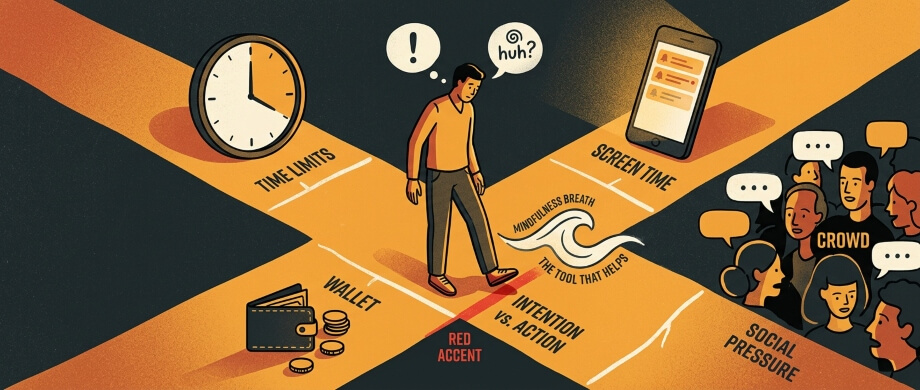
What Self-Control Actually Is
Psychologists draw a line between two systems in the brain. One is automatic. It reacts. It wants. The other is reflective. It plans. It delays.
The automatic system is fast. It feels like a pull in your chest, a tightness in your jaw, a thought that repeats: just this once. The reflective system is slower. It requires energy. When you’re tired, stressed, or distracted – which describes most of a student’s semester – the automatic system runs the show.
A 2025 study from UC Irvine put this in numbers. Participants completed a decision task where they could choose to control outcomes or let an external factor decide. Most people preferred control, except when controlling costs too much mental energy. Then they let go.
That’s the trade-off. Self-control is work. And work, when you’re already drained from class, studio, and everything else, is exactly what you don’t have energy for.
The STOP Technique: A Three-Second Pause
There’s a practice called STOP. It takes less time than checking your phone.
S — Stop. Whatever you’re doing. Just stop.
T — Take a breath. One breath. Feel it.
O — Observe. What’s happening in your body? Where’s the tension? What’s the thought looping in your head?
P — Proceed. Do the next thing. Not the thing the urge wanted. The next thing you actually meant to do.
A 2025 study at Ohio State found that five minutes of mindfulness at the start of class, three days a week, reduced student stress. Forty-seven percent said they managed stress better outside of class too. Not because the practice was long. Because it was consistent.
STOP works the same way. Three seconds. One breath. Enough to wake the reflective system before the automatic one acts.
Urge Surfing: When the Wave Passes
Alan Marlatt, a psychologist who worked with addiction and impulse behaviour, developed something called urge surfing in the 1980s. He noticed something: cravings don’t last. They feel infinite in the moment. But they peak. Then they fade.
He told clients to imagine the urge as a wave. You don’t fight it. You don’t drown. You ride it. You notice the physical sensation (tightness, heat, restlessness) and you stay with it. Not acting. Just watching.
A 2017 study found that urge surfing didn’t reduce how often smokers wanted a cigarette. But it did reduce how many they smoked. That’s the point. The urge still comes. The behaviour changes.
For students, this looks like: you want to check social media instead of writing that paper. You feel the pull. You notice it. You breathe. The pull stays for a minute. Then it softens. You write one sentence.
Why Limits Fail, and What Helps
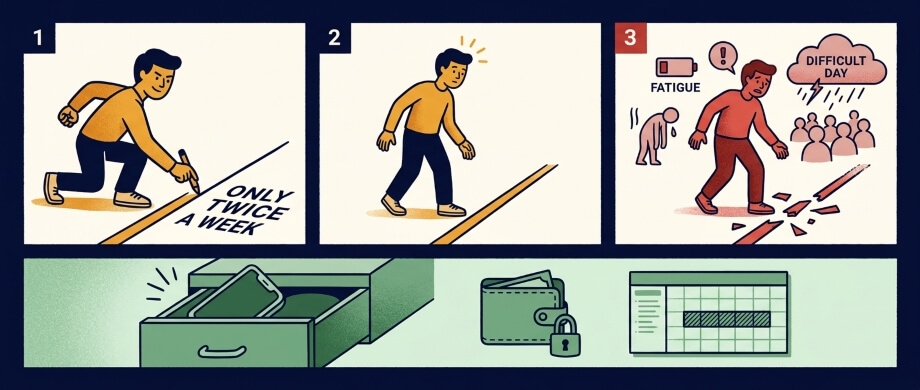
Research on self-control strategies consistently identifies three patterns.
First, people set limits. On frequency, time, spending. They say: only twice a week. Only an hour. Only twenty dollars. The limit feels reasonable in the moment of setting it.
Second, people try to stay aware. This means not just following a rule, but noticing in the moment when things are shifting, when the original plan is starting to bend. Researchers call this “playing smart”: being present to the decision as it’s happening, not just before and after.
Third, people recognize that their limits have limits. They know, sometimes explicitly, that they can’t rely on willpower alone. Adherence breaks down faster when other stressors are present: fatigue, social pressure, a difficult day.
That third point matters most. Not because it means giving up, but because it points to a more realistic strategy: building systems and environments that support the decision you meant to make, rather than relying on the reflective system to override the automatic one every single time.
When the Stakes Are Money: What Gambling Research Shows
One place where this pattern has been studied directly is gambling. Researchers in Quebec interviewed adults who play at online casinos, asking how they manage their own limits. The findings matched the three patterns above: people set time and money limits, tried to stay present, but still found themselves exceeding their own rules when tired, distracted, or around alcohol.
A national survey found that 45% of Canadian adults who gamble online set financial or time limits they couldn’t keep. Not because they didn’t care. Because willpower has a ceiling.
The Responsible Gambling Council ran a 2021–2022 campaign called “Mindfulness Before Gambling”. They used the visual language of meditation apps – soft colours, calm voiceovers – to deliver a practical point: decide your limits before the urge arrives, not during it.
The same logic applies to any high-stakes decision students face. The best time to set a study schedule is Sunday evening. The worst time is Thursday at midnight.
How Much Practice Actually Matters
A 2026 study with 636 participants compared 5-minute mindfulness practices to 20-minute ones. The finding: both worked. But for some people, shorter was better.
Participants lower in agreeableness, a personality trait associated with how people respond to structured guidance, showed stronger reductions in negative affect after shorter practices. People with different baseline levels of trait mindfulness also responded differently to different durations.
The researchers were honest about what this means: there is likely not a one-size-fits-all solution. Some people need five minutes. Some need twenty. Some need a different practice entirely.
The same logic applies to self-control. A three-second STOP might be enough to interrupt an automatic response. Or you might need urge surfing for five minutes. Or you might need to change your environment so the trigger doesn’t show up at all.
What We Don’t Know
Research on self-control is honest about its limits. Studies can document the pattern – limits set, limits broken – but the mechanisms that explain why some people can sustain awareness through a difficult moment and others can’t remain unclear. Higher stress loads, certain personality traits, and weaker support networks all correlate with lower adherence. But correlation is not a prescription.
One research participant described self-control as “like holding air in your hands. You can feel it for a moment, but it always escapes.”
That’s not a scientific finding. But it’s a real description of what limits feel like when they fail. And it’s why the most useful self-control strategies are the ones that don’t depend on perfect execution, that build in recovery, not just prevention.
Five Things That Can Help
- Decide before the moment. Self-control works best when the reflective system sets the rule before the automatic system faces the situation. Decide your limit when you’re calm. Before the deadline. Before the urge. Before the stakes feel real.
- Use STOP. Three seconds. One breath. Enough to create a gap between the impulse and the action.
- Surf the urge. When it feels unbearable, remind yourself: it will peak. It will fade. Don’t fight it. Watch it.
- Change the environment. If the pull is too strong, move. Walk outside. Put your phone in another room. Remove the trigger when you can. The reflective system doesn’t have to override the automatic one if the automatic one never gets activated.
- Don’t rely on willpower alone. Use external structure: timers, blockers, commitments made to other people. Recognizing that willpower has a ceiling isn’t failure. It’s realistic, and it leads to better strategies.
FAQ
Research on cravings suggests most peak within 10 to 20 minutes and then fade. Urge surfing works because it helps you stay present through the peak without acting. The urge doesn’t disappear, but it becomes survivable.
That happens sometimes. Noticing a sensation can amplify it before it fades. If that’s the case, try a different anchor: mindful walking, cold water, counting backward from 100. The goal is to engage the reflective system. The method matters less than consistency.
Yes. STOP, urge surfing, and pre-commitment are studied across contexts: procrastination, screen use, impulse spending, emotional reactivity, substance use. The mechanism is the same: automatic system, reflective system, and the gap between them.
Pick one situation where you tend to act impulsively. Set a plan before you enter it, when the reflective system is in charge. Use STOP when you feel the pull. If the urge passes, notice that it passed. If it doesn’t, try urge surfing for three minutes. The skill builds with repetition, not with willpower.
Disclaimer
This website is not affiliated with the original Mindful Campus Initiative, OCAD University, or the Centre for Mindfulness Studies. The domain was acquired after the grant period ended in 2024.
This page includes educational content about self‑control and mindfulness. The section on gambling research is included for illustrative purposes only and does not constitute an endorsement or promotion of gambling. If you are concerned about your own gambling behaviour, free and confidential help is available:
- Canada Problem Gambling Helpline: 1‑866‑531‑2600
- Good2Talk (Ontario post‑secondary students): 1‑866‑925‑5454
- Kids Help Phone (up to age 29): 1‑800‑668‑6868
If you are in crisis, call emergency services or your local mental health crisis line.