
You don’t need a meditation cushion. You don’t need to sit cross-legged for an hour or download a subscription app or believe in anything in particular.
Jon Kabat-Zinn, the biologist who created Mindfulness-Based Stress Reduction in 1979, kept the definition short: paying attention on purpose, in the present moment, and nonjudgmentally. That’s it.
In practice, for a student in the middle of a semester, it looks like this: noticing your breath for thirty seconds before opening a graded assignment. Recognizing that the voice telling you this work isn’t good enough is just a thought, not a verdict. Feeling the weight of a coffee mug instead of doomscrolling between classes.
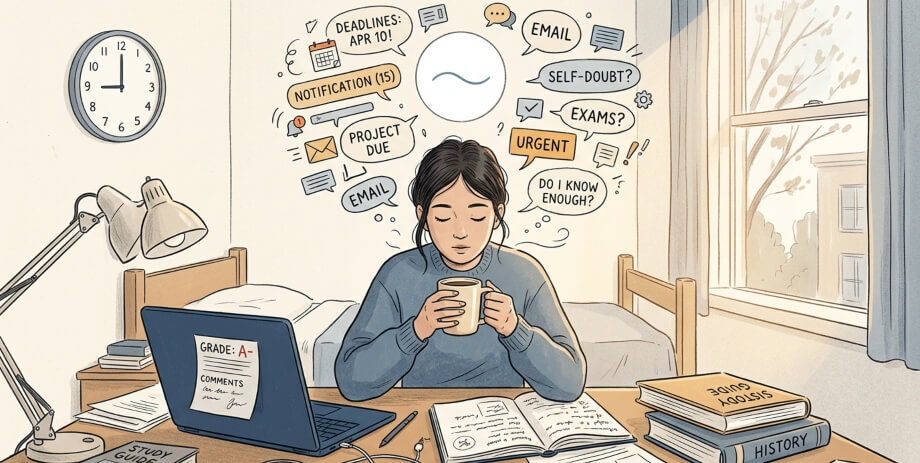
What Is Mindfulness? Definition, Science, and Benefits
The clinical definition – awareness that emerges through paying attention on purpose, in the present moment, and non-judgmentally (Kabat-Zinn, 2003) – is useful because it is precise. Mindfulness is not positive thinking. It is not relaxation. It is not the absence of thought.
It is a trainable skill: the ability to notice what is happening in your body and mind without immediately reacting to it. That gap between stimulus and reaction is where most of the benefit lives.
The evidence base is substantial. A 2024 systematic review of 29 randomised controlled trials found that MBSR-based programs produced significant reductions in perceived stress (SMD = −0.41), anxiety (SMD = −0.29), and depression (SMD = −0.32) among university students specifically. The same review found meaningful improvements in self-compassion scores (SMD = 0.57) – an outcome that matters especially in creative fields where critique is constant (Pan et al., 2024, Evidence-Based Complementary and Alternative Medicine).
A 2025 Ohio State study found that five minutes of mindfulness practice at the start of class, three days a week, was enough. Students reported less stress. Forty-seven percent said they managed stress better outside of class too.
Important: mindfulness is a complement to, not a substitute for, professional mental health care. If you are in crisis, please use the resources listed below.
Why Students and Creatives Need Mindfulness
The data on Canadian post-secondary student mental health is not ambiguous. A trend analysis of the National College Health Assessment II (NCHA II) documented significant increases between 2013 and 2019 in the proportion of Canadian students reporting psychological distress, diagnosed mental illness, and active help-seeking, with female students reporting consistently higher rates (Linden et al., 2021, BMC Public Health).
More recent data make the picture sharper: 83.7% of Canadian students reported experiencing a moderate to high level of stress in the past 30 days, and 80% reported overwhelming anxiety in the past 12 months, with 32% having received a formal anxiety disorder diagnosis (ACHA, 2022, as cited in Canadian Counselling and Psychotherapy Association, 2025).
For students in creative disciplines (visual arts, design, architecture, film), the pressure carries a specific texture. The Association of Independent Colleges of Art and Design found that only 25% of art and design students rated their mental health positively, compared to 42% of non-art students. A 2022 Nova Scotia survey of visual artists found that 74% had needed mental health supports at some point in their careers, and 70% reported that reduced well-being directly affected the quality of their work.
The top stressors were financial insecurity (73%), burnout (60%), feeling unable to live up to artistic potential (59%), and lack of self-confidence (53%). These aren’t personal failings. They’re structural – precarious employment, irregular income, a creative economy that demands constant output. The scale of financial anxiety among young Canadians has reached a new level: a November 2025 Mental Health Research Canada survey found that 67% of youth say living through recent financial crises has left them with long-term anxiety about financial security, compared to 55% of those aged 30 and older (MHRC, 2025).
Mindfulness doesn’t fix structural problems. But it builds coping skills and resilience – the capacity to observe criticism without collapsing into it, to notice creative blocks without catastrophising, and to return to the present task rather than spiralling into anxiety about outcomes. For art and design students under structural pressure, those resilience skills are worth developing.
Three Practices That Take Less Than 5 Minutes
No app, cushion, or retreat required. Three entry points:
1. Breath Counting (3–5 minutes)
Sit however you’re sitting. Close your eyes or don’t. Breathe normally. Count each exhale: one, two, three, up to ten. When you reach ten, start over. When your mind wanders (it will), notice where it went, then return to one. No judgment. Just restart. Restarting is the practice.
2. The 3-Minute Breathing Space
Developed within Mindfulness-Based Cognitive Therapy (MBCT), this micro-practice runs in three one-minute steps. Minute one: notice what is happening – thoughts, feelings, body sensations, without trying to change them. Minute two: gather attention entirely onto the breath. Minute three: expand awareness back outward to the whole body, breathing with whatever is there. Use it before a critique, before an exam, before any moment that tends to spike your anxiety.
3. Mindful Walking
Leave your phone in your pocket. Walk from one class to another. Pay attention to the physical sensations – the weight shifting from heel to toe, the air on your skin, the sounds around you. That’s it. No special route, no timer. Walking meditation requires no extra time. It transforms the movement you’re already doing into a grounding practice.
Start with five minutes per day. Consistency matters more than duration. A 2025 University of Central Florida study found that fifteen minutes of daily meditation improved mental clarity and reduced anxiety during lectures, but even five minutes, maintained regularly, produces measurable changes in stress reactivity.
Mindfulness and Mental Health: What the Research Says
The research is real. It’s also more nuanced than the wellness industry tends to admit.
A 2023 systematic review and individual participant data meta-analysis published in Nature Mental Health (Galante et al., 2023) confirmed beneficial effects on psychological distress across non-clinical adult populations, with effects maintained up to six months after program completion. Crucially, people with higher baseline distress showed greater benefit, which matters for students who are already struggling when they start.
A 2025 randomised controlled trial followed 153 university students through an eight-week structured mindfulness program. Academic stress dropped significantly. Burnout followed. Psychological resilience more than doubled in effect size. Benefits held at the two-week follow-up.
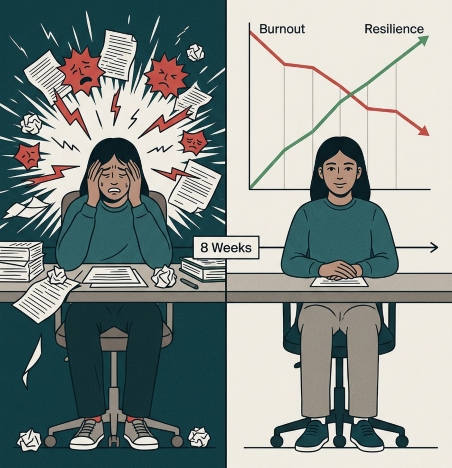
A separate 2025 study on test anxiety tracked 105 students through twelve weekly sessions. The mindfulness group’s test anxiety scores fell. Psychological adaptability improved. Academic grades didn’t change, the researchers were honest about that, but students handled exams better.
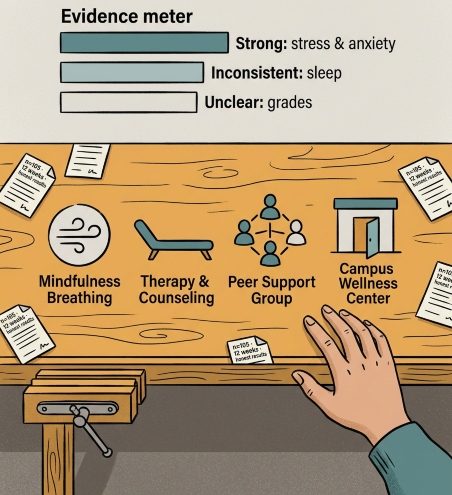
Where the evidence is cautious: sleep quality hasn’t shown consistent improvement in controlled trials among students. Effects on subjective well-being are inconsistent. Most studies have small sample sizes and short intervention windows.
The honest summary: mindfulness is a well-supported tool for stress and anxiety management within a broader approach that may include therapy, peer support, and campus wellness programs. It is not the only tool. It is not always the right tool. But it costs nothing to try, and for many students, it works.
Mindfulness Programs at Canadian Post-Secondary Institutions
A number of Canadian universities have introduced structured mindfulness initiatives and campus programs to support student well-being. The following examples are described for informational purposes; the institutions listed operate independently of this website.
- University of Toronto: Mindfulness@UofT, offered through the Health & Wellness centre, provides MBSR-based group programs and drop-in sessions throughout the academic year.
- McGill University: the Wellness Hub offers mindfulness workshops and self-guided resources as part of its broader student mental health programming.
- University of British Columbia: the Mindfulness Meditation Community runs regular sessions open to students across all faculties.
- Concordia University: the Zen Den at the EV building offers peer-supported drop-in mindfulness sessions for Faculty of Fine Arts students.
Between 2023 and 2024, a federally funded campus program known as the Mindful Campus Initiative (MCI) was active at several Canadian art and design institutions, on the OCAD campus in Toronto, as well as at Concordia, NSCAD, KPU, and York University, with programming developed specifically for creative students.
That initiative concluded when its Public Health Agency of Canada grant ended. Its curriculum was built in partnership with the Centre for Mindfulness Studies, a Toronto-based mental health charity with over a decade of experience delivering evidence-based programs. The domain mindfulcampus.ca previously hosted that program’s resources. The institutions involved maintain their own wellness services on their official websites.
Freely available mindfulness video resources for students are also collected on the video resources page.
To find mindfulness resources at your own institution, search for “[your university] student wellness centre” or contact your campus health services directly.
Free Online Mindfulness Resources for Students in Canada
The following resources are free, verified, and available to Canadian post-secondary students. They are listed for informational purposes only. This website is not affiliated with any of them. Cost matters here: a 2025 Mental Health Research Canada survey identified cost as the leading barrier to accessing mental health care, cited by 52% of young Canadians (MHRC, November 2025). Every resource below is free.
Resource | What it offers | What it offers |
|---|---|---|
Good2Talk | Free professional helpline, 24/7, for post-secondary students in Ontario. Call, text, or Facebook Messenger. Available in 100+ languages through interpreters. | 1-866-925-5454 good2talk.ca |
BounceBack (CMHA) | Free skill-building program for mild to moderate depression, anxiety, or stress. Available across Canada to adults and youth 15+. | bouncebackontario.ca |
Kids Help Phone | 24/7 crisis support for people up to age 29. Text, call, or live chat. | Text HELLO to 686868 kidshelpphone.ca |
CAMH | Evidence-based mental health information and resources for Canadians. | camh.ca |
Palouse Mindfulness | Free, self-paced, complete 8-week MBSR course. No registration required. | palousemindfulness.com |
UCLA Mindful | Free guided meditations in multiple languages. App and website. | uclahealth.org/mindful |
Your campus wellness centre | Most Canadian universities offer free counselling, peer support, and mindfulness sessions. Search your institution’s name + “student wellness”. | — |
The WHO reports that one in seven adolescents globally experiences a mental health disorder, and most never receive treatment. If you’re struggling, you’re not alone, and help is available.
FAQ: Common Myths About Mindfulness
The most common misconception. A thought-free mind isn’t possible for extended periods, and it’s not the goal. The practice involves noticing thoughts as they arise and returning attention to an anchor (breath, body, sounds) when the mind wanders. A busy, wandering mind during practice is not failure. The returning is the practice.
Studies show measurable effects with sessions as brief as 5–15 minutes daily over several weeks. The 2025 Ohio State research found benefits from five minutes at the start of class, three days a week. A short practice you maintain is more effective than a long one you attempt once.
Modern evidence-based mindfulness (MBSR, MBCT) is a secular practice developed in clinical and academic settings. While it draws on attention-training methods found in various contemplative traditions, the clinical form has no religious content or requirements. It is studied and taught in hospitals, universities, and workplaces.
The evidence suggests the opposite. The 2023 Nature Mental Health meta-analysis found that people with higher baseline distress tend to show greater benefit from mindfulness-based programs (Galante et al., 2023). The caveat: for severe mental illness, mindfulness alone is rarely sufficient and works best alongside professional treatment.
Relaxation is a side effect, not the goal. Mindfulness develops the capacity to observe experience, including uncomfortable thoughts and emotions, without automatic reactivity. Sometimes practice surfaces things you’ve been avoiding. If that becomes overwhelming, stop and talk to a counsellor. Mindfulness isn’t for everyone, and that’s fine.
No evidence supports this. Research suggests high creative involvement can correlate with higher emotional reactivity and rumination, which makes deliberate mindfulness practice particularly valuable for students in art and design disciplines, not redundant.
This website is not affiliated with the original Mindful Campus Initiative, OCAD University, the Centre for Mindfulness Studies, or any other post-secondary institution. The domain was independently acquired after the initiative’s grant period ended in 2024. Content here is educational and informational only. If you are in crisis, call emergency services, Good2Talk at 1-866-925-5454 (Ontario), or Kids Help Phone at 1-800-668-6868.