
No appointment. No campus gym membership. No cushion.
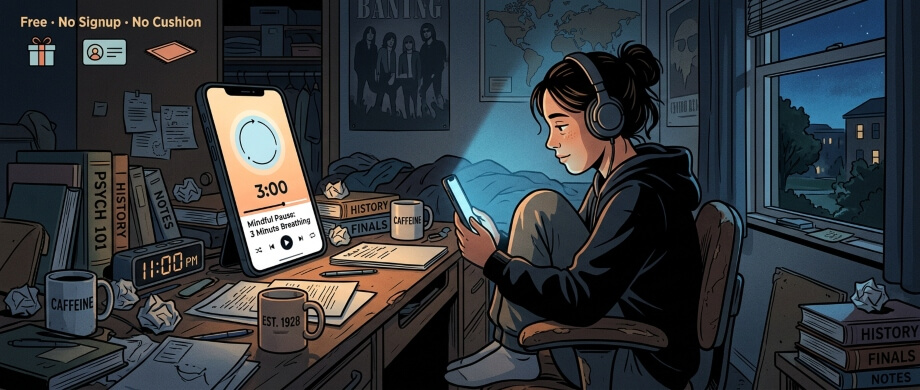
A guided meditation video takes three minutes. You can watch it on your phone between classes, in your car before a shift, or at your desk at 11 p.m. when the deadline stress hits. For students who can’t fit a scheduled class into a packed timetable, video is often the only mindfulness practice that happens.
What’s here: a curated collection of mindfulness videos for students, all free and available online without signup. A short guide to practice types so you know what you’re looking for. The best free channels worth bookmarking. And one full self-paced course, for when five minutes a day isn’t quite enough anymore.
Note: The domain mindfulcampus.ca previously hosted a structured video library, sometimes referenced as Mindful Campus video resources or Mindful Campus work, developed for Canadian art and design students through a federally funded initiative. Those materials were produced for institutional use and are not reproduced here. The resources below are independently curated from publicly available third-party sources.
Why Video Works for Student Wellness
The research on mindfulness and stress in post-secondary students is consistent: even short practices produce measurable reductions in anxiety and perceived stress when maintained over several weeks. The obstacle is almost never motivation. It’s student access – access to affordable, flexible, stigma-free practice that fits around a packed schedule.
Campus wellness programs are real, but they have waitlists. Apps cost money. And a lot of students, especially those in art and design programs working around studio hours, part-time jobs, and critique schedules, can’t make a fixed Tuesday evening session work.
Video changes that equation. A 2025 Ohio State study found that five minutes of guided mindfulness at the start of class, three days a week, reduced student stress and improved stress management outside of class. Five minutes. Three days a week. That’s a YouTube video before your first lecture.
Self-paced learning through video also removes the social pressure some students feel in group settings. You don’t have to sit correctly, breathe loudly, or perform calm. You can pause, rewind, and try again tomorrow.
Types of Mindfulness Practices: What the Videos Cover
Not all mindfulness videos are the same. University wellness centres, guided meditation programs, and independent clinicians each tend to emphasize different practice types. Before you search, it helps to know what you’re looking for. There are four main categories you’ll find in most free resources:
Breath awareness
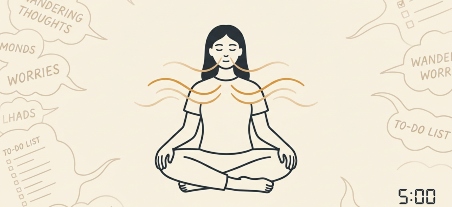
The most common starting point. You focus attention on the physical sensation of breathing, the rise of the chest, air at the nostrils, and return to that focus when your mind wanders. Five to ten minutes is a full practice. This is what most “guided meditation” videos for beginners cover.
Body scan
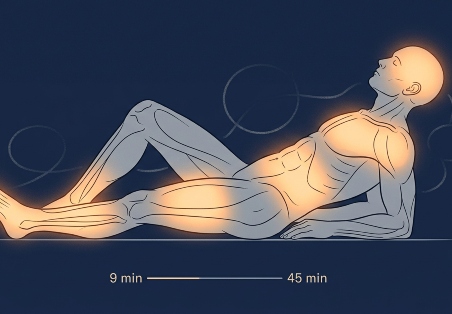
A slower, more systematic practice: you move attention deliberately through different parts of the body, noticing sensation without trying to change anything. Body scan videos run anywhere from nine minutes to forty-five. The Oxford Mindfulness and UCLA Mindful versions are among the most clinically grounded available for free. Research shows body scan is particularly effective for physical tension and rumination, both common in students during high-stakes periods like crits or finals.
Mindful movement
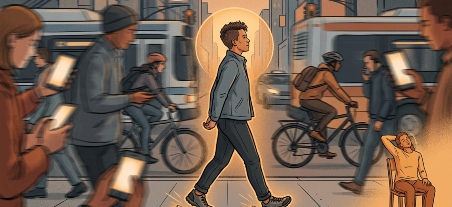
Meditation doesn’t require stillness. Mindful walking, yoga, and seated movement practices use physical activity as the anchor instead of the breath. Useful for students who find it difficult to sit still, or who want a practice they can do during the commute.
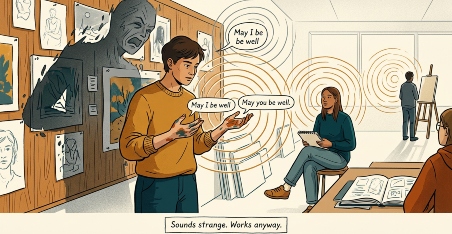
Loving-kindness (mettā)
A practice of directing phrases of goodwill toward yourself and others. Evidence links it to improved self-compassion and reduced self-criticism, which matters particularly for students in high-critique disciplines like design or fine arts, where the internal critic tends to run at full volume. Sounds strange. Works anyway.
Best Free Guided Meditations in 2026
Eight videos. One per category, plus a few extras for specific situations. All are from university wellness services, licensed clinicians, or research-backed organizations. All are free. None require a signup.
Title | Channel / Source | Practice type | Length | Best for |
|---|---|---|---|---|
Breathing Meditation | UCLA Mindful | Breath awareness | 5 min | First-timers; before exams |
3-Step Breathing Space | Oxford Mindfulness (YouTube) | MBCT micro-practice | 3 min | Mid-day reset; pre-critique |
Guided Body Scan | Oxford Mindfulness / Mark Williams (YouTube) | Body scan | ~20 min | Deep stress release; evening |
Loving Kindness Meditation | UCLA Mindful | Loving-kindness | 8 min | After difficult feedback |
Mindful Walking | George Brown Polytechnic Counselling (YouTube) | Mindful movement | ~8 min | Between classes; campus transit |
Breathing & Stress Practices | George Brown Polytechnic Counselling (YouTube) | Breath + daily life | ~10 min | General stress; beginners |
9-Minute Body Scan: Anxiety Skills | Therapy in a Nutshell (YouTube) | Body scan / CBT | 9 min | Exam anxiety; creative blocks |
The Power of Mindfulness | Shauna Shapiro (via Palouse Mindfulness) | Explainer / talk | 13 min | Understanding why it works |
UCLA Mindful recordings are released under a Creative Commons Attribution-NonCommercial-NoDerivatives licence. Oxford Mindfulness is a not-for-profit partner organization of the University of Oxford. George Brown videos are produced by campus counsellors for student use.
Starting a Home Practice: What Actually Helps
The research is honest about this: most people who try mindfulness once don’t stick with it. The ones who do tend to share a few habits that have nothing to do with talent or personality.
- Same time, same place. Not because it’s spiritual. Because habit formation is neurological. The brain encodes context. Students who attach practice to an existing trigger, right after morning coffee, right before the first lecture, right when the laptop opens, are more likely to sustain it than those who rely on motivation alone.
- Start smaller than you think you need to. A 2025 University of Central Florida study found measurable benefits from fifteen minutes of daily meditation. But the relevant finding is what happened at five. If you can’t do five minutes consistently, two minutes consistently is better than fifteen minutes once. Pick the video length you can actually finish.
- Use headphones. Not for audio quality. Because it signals to your nervous system that you’ve created a boundary. Students in shared dorms or apartments report that headphones are the single most useful setup element.
- When you miss a day, don’t restart. The research on habit formation is clear: missing once doesn’t break a habit. Missing twice starts to. The most useful instruction after a missed practice is “do one minute right now” – not starting over from day one.
- Don’t optimize. Students have a tendency to research the best mindfulness technique before starting. The evidence doesn’t support strong preferences between techniques for beginners. Breath awareness, body scan, loving-kindness – start with whichever video description sounds least annoying to you.
Recommended Channels and Free Courses
These are the free mindfulness resources worth bookmarking – video resources from university wellness centres, licensed clinicians, and non-profit organizations. One full self-paced course. Five channels that consistently produce evidence-grounded content.
Channel / Site | Type | Cost | What’s there |
|---|---|---|---|
UCLA Mindful uclahealth.org/uclamindful | University wellness centre | Free | 12 guided meditations (5–19 min), Creative Commons licence, app available |
Oxford Mindfulness oxfordmindfulness.org | University-linked non-profit | Free | Body scan, breathing space, and sitting meditations with Mark Williams; YouTube + podcast |
George Brown Polytechnic Counselling georgebrown.ca | Campus counselling service | Free | Counsellor-led videos: breathing, walking, body scan, movement practice |
Therapy in a Nutshell YouTube | Licensed therapist | Free | Anxiety skills series; CBT and mindfulness combined; high production quality |
Palouse Mindfulness palousemindfulness.com | Non-profit MBSR course | Free | Full 8-week MBSR course; videos, readings, guided practices; 8,000+ graduates; no registration |
MIEA – Mindfulness Institute for Emerging Adults miea.com | Evidence-based higher ed programme | Free tutorials | Breathing, walking, body scan tutorials designed specifically for students aged 18–30 |
Palouse Mindfulness is worth singling out. It’s a complete, self-guided version of the clinical MBSR course – the same eight-week programme that’s been studied in hundreds of randomised controlled trials. More than 8,000 students from 120 countries have completed it. There are no fees, no passwords, no spam. The course includes video teachings from Jon Kabat-Zinn, Tara Brach, and Sharon Salzberg. It’s the best free structured mindfulness resource available online, and it requires nothing except time.
FAQ
No. Every resource in the list above is suitable for complete beginners. If a video description says “for beginners” it means no prior practice is assumed. If it says “intermediate” or “advanced,” it usually means you’ve done some guided meditation before. The UCLA Mindful Breathing Meditation (5 min) and the George Brown breathing videos are the lowest-barrier starting points on this list.
The honest answer is less than you think, more consistently than you expect. A 2025 Ohio State study found benefits from five minutes at the start of class, three days a week. The full clinical MBSR programme uses 45 minutes daily over eight weeks. For students starting out, five to ten minutes daily produces measurable changes in stress reactivity within four to six weeks. Duration matters less than regularity.
A guided meditation video is a single practice: you follow along, it ends, you’re done. A mindfulness course structures practices progressively over several weeks, builds conceptual understanding alongside the practice, and usually includes readings and reflection as well as audio or video. For most students, starting with individual videos is the right move.
It can happen. Bringing attention to the body and breath can surface things you’ve been avoiding. If a specific practice consistently increases your anxiety, try a different type – mindful walking tends to be more grounding than still body scan for people who are already activated. If mindfulness practice in general increases rather than decreases distress, it’s a signal to speak with a counsellor. Mindfulness isn’t the right tool for everyone, and that’s fine.
Yes. Every video in the curated table is freely available on YouTube or university websites without signup. UCLA Mindful and Oxford Mindfulness have apps that are also free. Palouse Mindfulness has no fees, no registration, and no passwords. The only exception is MIEA, which offers free tutorials but has paid teacher training programmes – the free materials are clearly labelled on their site.
This website is not affiliated with the original Mindful Campus Initiative, OCAD University, the Centre for Mindfulness Studies, or any other post-secondary institution. The domain was independently acquired after the initiative’s grant period ended in 2024. Content here is educational and informational only. If you are in crisis, call emergency services, Good2Talk at 1-866-925-5454 (Ontario), or Kids Help Phone at 1-800-668-6868.